
Acoustic vehicle alerting systems, or AVAS, support pedestrian safety around electric vehicles. Suitable acoustic instrumentation is essential for evaluating alert sounds. This historical article sets out five selection considerations.
1. Applicable regulations
The source cites UNECE R138, China's GB/T 37153-2018 and US NHTSA requirements. It gives a sound-level range of 56–75 dB and refers to frequency characteristics. Instrument selection must meet the accuracy requirements of the applicable procedure.
2. Accuracy class
The source specifies Class 1 instrumentation conforming to IEC 61672-1 and GB/T 3785.1 for R138 measurements, rather than Class 2.
| Item | Class 1 | Class 2 |
|---|---|---|
| Intrinsic error stated in the source | ±0.7 dB | ±1.0 dB |
| Frequency range | 16 Hz–20 kHz | 20 Hz–8 kHz |
| Operating temperature | −10–50°C | 0–40°C |
3. Main parameters
- Frequency range: the source recommends coverage of 16 Hz–20 kHz, preferably 10 Hz–20 kHz for margin.
- Frequency weighting: A weighting for primary measurements and C weighting for peak assessment.
- Time weighting: Fast, F, with a 125 ms time constant; Slow is unsuitable for the stated procedure.
- One-third-octave analysis: Class 1 performance under IEC 61260-1.
The article also recommends a dynamic range of at least 120 dB and an adequate sampling rate.
4. Calibration equipment and verification
- Use a Class 1 acoustic calibrator conforming to IEC 60942.
- Calibrate before and after each measurement. The difference must not exceed 0.5 dB; otherwise the results are invalid.
- The source recommends annual calibrator verification and sensor verification every two years.
5. Brands and system configuration
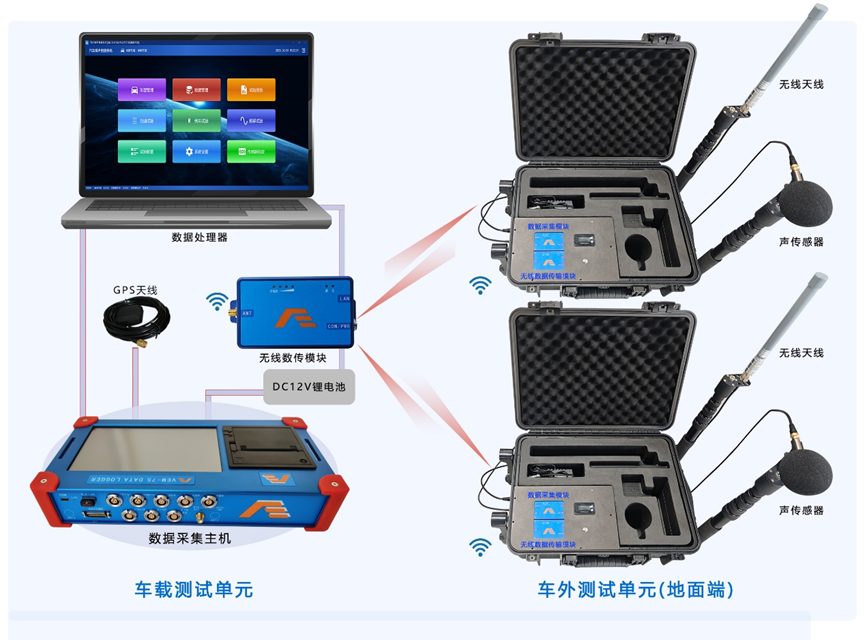
The article mentions Brüel & Kjær and Svantek as international options, and Aihua and Hengyi as domestic options. A complete low-speed alert test system combines acquisition hardware, microphones, a calibrator and triggers for automated testing.
Selection should follow the applicable procedure, with appropriate accuracy, frequency response, one-third-octave analysis and calibration.
Luoyang Naiou Electric has more than ten years of automotive testing experience. Its low-speed alert system supports the procedures cited in UNECE R138 and GB/T 37153 and also acceleration exterior noise testing under GB 1495, combining several noise test applications. Contact us for further information.