
A draft recommended national standard, Technical Requirements and Test Methods for Passenger Car Steer-by-Wire Systems, proposed and administered by the Ministry of Industry and Information Technology, has been released for public consultation. It establishes a framework for a key actuator technology in advanced automated driving.
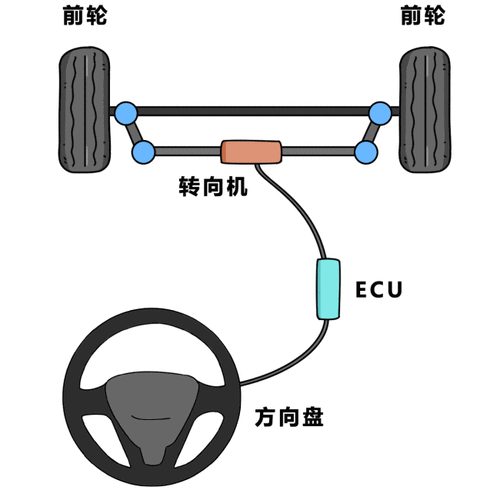
Conventional steering uses a mechanical connection between the steering wheel and road wheels. Steer-by-wire can remove that physical link: driver input becomes an electrical signal, and motors at the road wheels perform the steering action. Potential benefits include faster response and more precise control, supporting safety, comfort and intelligent chassis functions.
Why a dedicated standard?
Removing the mechanical connection introduces new challenges. The driver still needs natural steering feel, and the vehicle must remain controllable after a fault. Common technical requirements are needed. The draft draws on the experience of domestic suppliers and manufacturers to provide a basis for design, validation and evaluation.
Main provisions described in the draft
Functions and performance: alignment of steering input and output, with the source specifying deviation no greater than 5° over 95% of the angular range and a mechanical stop failure torque of at least 100 N·m. Variable steering ratio and angle alignment are evaluated.
Degraded operation: normal state, degraded state 2 and degraded state 3, and transitions between them, support controllability after a single-point failure. The source refers to alignment with ISO 19725.
Data recording: locked records of collisions and severe steering faults, with dynamic parameters sampled at 10 Hz, support incident investigation.
Electromagnetic compatibility and cybersecurity: additional checks address abnormal angle fluctuations and abrupt torque changes, and steering is managed as a critical vehicle cybersecurity element.
Functional safety: alignment with Appendix B of GB 17675, including hazard analysis, risk assessment and associated testing.
Industry impact
The standard offers manufacturers and suppliers a clearer route from prototype validation to series production. Testing organisations face additional static and dynamic performance tests, degraded-state transitions and electromagnetic compatibility assessments.
Luoyang Naiou Electric continues to follow steer-by-wire, brake-by-wire and intelligent chassis testing technologies. We provide vehicle performance evaluation and data recording solutions to support industry partners as standards evolve. Please contact us for further information.