
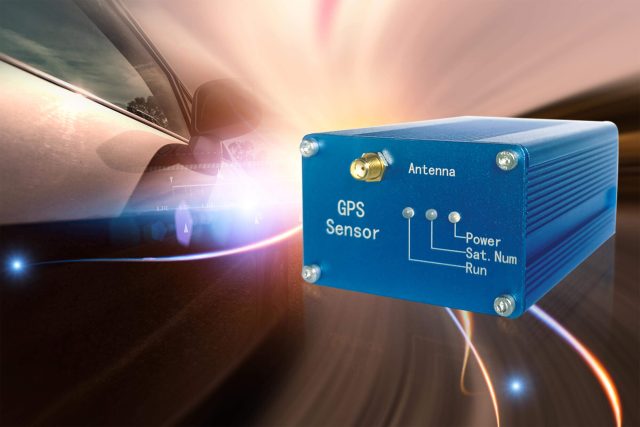
GPS speed meter and vehicle speed sensor
Overview
GPS vehicle speed test sensor takes GNSS board card as the core, with high-speed embedded microprocessor, converts GPS signal into three forms of pulse, RS232 and analog voltage signal. Supports all GNSS systems, including GPS, GLONASS, BeiDou and Galileo. RTK is also supported, with a new hardware platform and interference-resistant algorithms. The product has the characteristics of low power consumption and abundant communication interfaces.
Main features:
- Rich functions: built-in high-precision brake trigger logic circuit.
- Selected parts and accessories: The connectors are imported products to ensure reliable connection of the products.
- USB interface: The sensor can be connected to a computer through a USB interface to achieve precise measurement of speed and distance. It can also be connected to the PCM series data collector produced by our company.
- High precision: Built-in high-precision brake trigger logic circuit, using intelligent real-time interpolation algorithm, ranging accuracy reaches the international level, suitable for speed testing of automobiles, trains, high-speed rail, ships, etc., The sensor is especially suitable for rapid deceleration, emergency Accelerated high-dynamic and high-precision speed measurement occasions.
- Easy to upgrade: It can perfectly replace the traditional grounded fifth-wheel instrument or non-contact photoelectric vehicle speed sensor. The original test instrument based on the traditional grounded fifth-wheel instrument or non-contact photoelectric vehicle speed sensor can be upgraded to simply by replacing the sensor. The most advanced GPS speed measurement method eliminates the trouble of replacing the instrument host or redeveloping and purchasing the instrument host, saving you time and money.
- Rich interfaces: pulse output, RS232, analog voltage signal 3 signal output forms can be matched and combined, and the signal output form can be customized through the communication protocol.
- High cost performance: Using the original intelligent real-time interpolation algorithm, the sensor data update frequency can be increased up to 1000Hz. The measurement accuracy is better than similar international products, but the price is favorable.
Application areas:
- The GPS vehicle speed sensor can be used for the highest car speed test, the lowest stable speed test of the car, the acceleration performance test of the car, the traction performance test of the car, the coastdown test, the measurement test of the consumption limit of the operating passenger car, the measurement test of the fuel consumption of the operating truck, and the fuel consumption of the car Measurement test, automobile speedometer, odometer calibration and correction, motor vehicle and trailer anti-lock braking performance and test, automobile handling stability test, commercial vehicle rollover stability test, road vehicle heavy commercial vehicle train and articulated bus Lateral stability test, car ride comfort test.
Reasons for upgrade:
- Traditional grounded fifth-wheel instrument has stable pulse output at low speed (even interval), but it is bulky and inconvenient to install, and due to the fifth-wheel dynamic balance problem and uneven ground, it will cause large measurement errors at high speed;
- The non-contact photoelectric vehicle speed sensor (also known as the photoelectric head) is much easier to install than the traditional grounded fifth-wheel instrument, but its actual use accuracy has many factors, such as road conditions, illumination, installation direction and height, etc., and the above-mentioned influencing factors are very It is difficult to control. In addition, due to the existence of the tracking filter board, the output distance pulse is not very uniform at a stable vehicle speed. Therefore, the non-contact photoelectric vehicle speed sensor is not suitable for real-time vehicle speed measurement (such as ABS test).
- Compared with the above two test devices, GPS speed sensor is extremely convenient to install and use, and can realize accurate measurement of braking distance. It is an ideal device for measuring vehicle speed.
Technical specifications
Swipe horizontally to view all table columns.
GPS Vehicle speed sensor specifications
| GPS update frequency (Hz) | 100 | 20 | 10 | 5 |
| Interpolated output frequency (Hz) | 1000 | 600 | 400 | 200 |
| Active antenna | Imported 3~5V high gain and low voltage | Imported 3~5V high gain and low voltage | Domestic 3~5V high gain and low voltage | Domestic 3~5V high gain and low voltage |
| Raw speed accuracy | 0.03m/s(0.1km/h) | 0.03m/s(0.1km/h) | 0.1m/s(0.36km/h) | 0.1m/s(0.36km/h) |
| Speed range | 0km/h~720km/h | 0km/h~720km/h | 0km/h~720km/h | 0km/h~720km/h |
| Distance pulse output frequency | 10Hz~25kHz | 10Hz~25kHz | 10Hz~25kHz | 10Hz~25kHz |
| Pulse equivalent | 1~10mm/pulse (default 4mm) | 1~10mm/pulse (default 4mm) | 1~10mm/pulse (default 4mm) | 1~10mm/pulse (default 4mm) |
| Distance measurement accuracy | Better than ±0.3% (absolute accuracy ±10cm) | Better than ±0.5% (absolute accuracy ±20cm) | Non-high dynamic conditions are better than ±0.5% | Non-high dynamic conditions are better than ±0.5% |
| Speed frequency conversion accuracy | Better than 0.03% (0.1km/h) | Better than 0.03% (0.1km/h) | Better than 0.03% (0.1km/h) | Better than 0.03% (0.1km/h) |
| Speed frequency conversion resolution | Better than 0.00025Hz (0.0036km/h) | Better than 0.00025Hz (0.0036km/h) | Better than 0.00025Hz (0.0036km/h) | Better than 0.00025Hz (0.0036km/h) |
| Processor clock (MHz) | 100 | 100 | 50 | 50 |
| Connector quality | imported | imported | domestic | domestic |
| Display function | 3 LED indicators or 1.54-inch OLED display (optional, order specified) | |||
| input interface | Standard configuration: SMA antenna, power input Optional: pedal trigger switch, RTK digital radio module and antenna, 4G module ( does not support) | |||
| Output interface | Standard 4 options 1: (1) distance pulse output; (2) RS232 communication; (3) vehicle speed voltage output (0~5V); (4) RS485 communication Optional: Pedal switch output, TTL level, low level effective | |||
| Power supply | 12V, power consumption is about 3W | 12V, power consumption is about 3W | 12V, power consumption is about 2W | 12V, power consumption is about 2W |
Applications
Applications with other test equipment
- Vehicle speed tests
- Steady vehicle speed tests
- Vehicle acceleration tests
- Other vehicle test applications
Reasons to upgrade to GPS speed measurement
Traditional ground-contact fifth-wheel instruments provide evenly spaced pulses at low speeds, but are bulky and difficult to install. Wheel imbalance and uneven ground increase measurement errors at high speeds.
Non-contact optical speed sensors are easier to install, but their accuracy depends on road conditions, lighting, installation direction and height. These factors are difficult to control. Tracking filters can also produce uneven distance pulses at steady speed, making this approach unsuitable for real-time speed measurement such as ABS tests.
Compared with these approaches, GPS speed sensors are convenient to install and use and provide accurate braking-distance measurement.

Reasons to upgrade to GPS speed measurement
Need selection advice or a quotation?
Submit your test items and vehicle type. The sales representative for your region will call you back.