
Braking effort alone does not describe safe braking. Anti-lock braking helps maintain control when wheel lock would otherwise cause unstable movement. Manufacturers and evaluation organisations therefore test ABS performance.
Operating principle
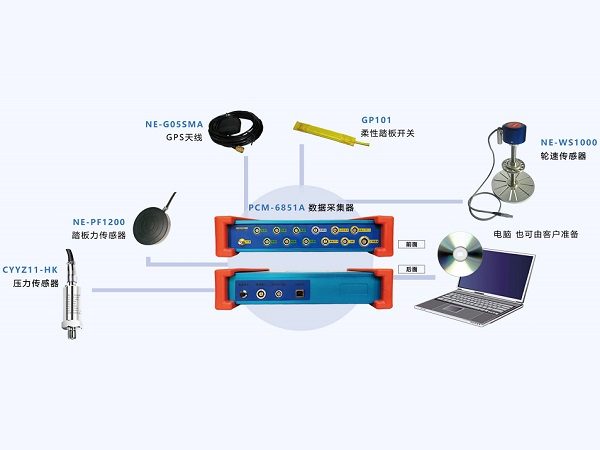
The system comprises a data acquisition unit, GPS speed sensor, pressure sensors, wheel speed sensors, pedal force sensor and laptop running ABS analysis software. During emergency braking, it records vehicle speed, inlet pressure, wheel speeds and pedal signals in real time. Data are transferred to the laptop for processing, curve display and comprehensive evaluation of braking performance.
Sensor functions
- Wheel speed sensors convert rotational speed into electrical signals so wheel lock can be identified. Magnetic induction sensors are commonly used.
- The GPS speed sensor provides vehicle speed and deceleration measurements. The source describes using these measurements in the assessment of slippery surfaces such as snow and ice.
- The pedal force sensor detects pedal application and measures effort. Its output can be compared with the ABS controller's braking flag to assess detection accuracy.
- Pressure sensors measure pressure changes during braking. The source relates brake chamber pressure to braking torque, allowing different ABS systems' pressure control behaviour to be analysed.
- The acquisition unit connects the system components through GPS, vehicle speed, laptop and power interfaces. All connections must be correct.
Luoyang Naiou Electric's ABS test system uses high-accuracy hardware speed measurement with a measurement period as short as 1 ms. Please leave an enquiry or contact customer service for details.