
Fuel economy is an important consideration for vehicle buyers. Manufacturers and testing organisations evaluate it using defined indicators and procedures.
Evaluation indicators
Fuel economy describes the ability to perform transport work with less fuel. A common indicator is fuel consumption in litres per 100 km, obtained from sample vehicles using specified test methods.
Constant-speed consumption
Drive in the highest gear at different steady speeds over a specified distance on a flat, firm road. Record fuel consumption and average runs in both directions. Plotting consumption against speed typically produces a curve with a minimum at the most economical speed. A manufacturer's figure measured at this speed is a reference value; ordinary driving seldom reproduces the same conditions.
Driving-cycle consumption
A defined route combines steady speed, acceleration and deceleration, sometimes including starting and idling. Fuel use is converted to litres per 100 km. The historical article describes a weighted combination of cycle and specified constant-speed results as a combined value, and notes that some specifications label them urban consumption and constant-speed consumption.
Test methods
- Uncontrolled road tests: do not control the influencing factors. They reflect vehicle type, road conditions, traffic, load and climate, closely representing real use, but take a long time and cost more.
- Controlled road tests: hold one or more factors constant while measuring fuel use. Average speed may be specified approximately, while traffic, driving habits, temperature and wind are not fully controlled. Similar tests can be conducted on dedicated proving-ground roads.
- Road-cycle tests: follow a defined speed-time schedule, specifying gear changes, braking times, speeds, acceleration and deceleration. The cycle can include steady speed, acceleration, braking and idling consumption.
- Laboratory-cycle tests: reproduce a cycle on a chassis dynamometer or roller test bench. Indoor testing is independent of weather and allows conditions to be controlled, reducing environmental correction requirements.
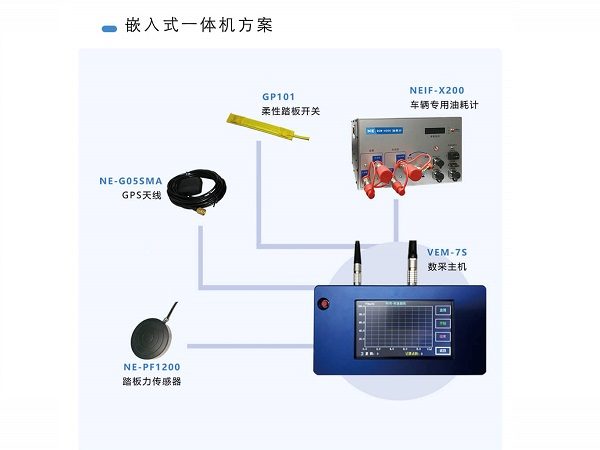
Luoyang Naiou Electric supplies vehicle road test instruments, fuel economy testing solutions and peripheral sensors. Please leave an enquiry or contact customer service for details.