
Road tests require accurate vehicle speed measurements throughout acceleration, braking and other manoeuvres. Speed sensors therefore have demanding performance requirements.
Sensor requirements
- Stability and reliability: prerequisites for accurate speed measurements.
- Consistent standards and specifications: support standardised test systems, software, hardware selection and instrument interfaces.
- Fast response: use mature, reliable technology capable of responding quickly.
- Measurement accuracy: select sensors and acquisition systems that meet the required speed accuracy.
- Maintainability and economy: a sensible structure, simple wiring, modular software, low failure rate and good cost-performance balance.
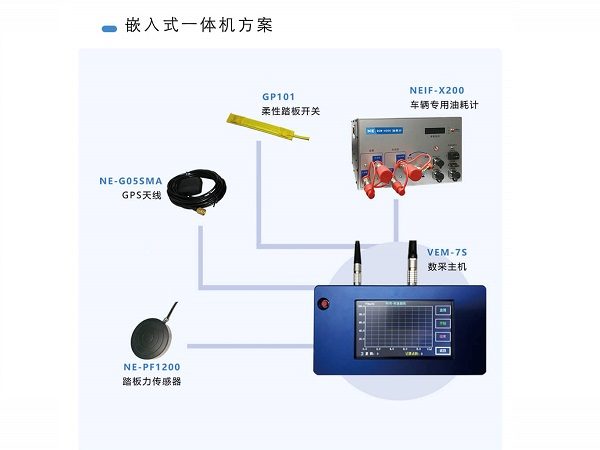
GPS speed sensor characteristics
Naiou's systems use GPS speed sensors that provide pulse, RS232 and analogue voltage outputs for different instruments.
- The source specifies a speed range of 0–255 km/h and sensitivity of 512 (km/h)/V. GPS receivers operating above 20 Hz can improve sampling performance and reduce error.
- Repeated practical trials reported stable operation without interruptions or lock-ups, and normal thermal and interference resistance performance.
- GPS provides both real-time position and instantaneous speed, with good adaptability to test sites and environments.
- A GPS sensor can replace a contact fifth-wheel instrument or non-contact optical speed sensor, avoiding the time and expense of replacing or redeveloping the main unit.
Luoyang Naiou Electric develops vehicle road test instruments for acceleration, fuel economy, braking and handling stability. Please leave an enquiry or contact customer service for details.