
Braking performance is an important measure of vehicle safety. Tests are conducted before delivery and after a period of use or a specified mileage. Suitable test conditions are essential for reliable results. The conditions below are reproduced from the historical source article.
Test conditions
- Use a dry, level and clean concrete road, or a surface with equivalent adhesion. The longitudinal gradient over any 50 m section is less than 1%, and road crossfall is less than 2%.
- Wind speed is below 5 m/s and ambient temperature does not exceed 35°C.
- For laden tests, use the manufacturer's maximum gross mass with the load evenly distributed and axle loads as specified. Where several axle-load distributions are possible, the ratios of actual to permissible axle load should be equal.
- For unladen tests, fill fuel to 90% of the specified tank capacity, top up coolant and lubricants, carry onboard tools and the spare tyre, and include 200 kg for the driver, a test operator and instruments.
- For cab-only vehicles, a load representing the body may be added, without exceeding the vehicle's kerb mass.
- Adjust the braking system and bed in the brakes before testing.
- Inflate tyres to the specified pressure within 10 kPa; tread height is at least 50% of that of a new tyre.
- When simulating braking system failure, the device used must not affect normal performance of the part being tested.
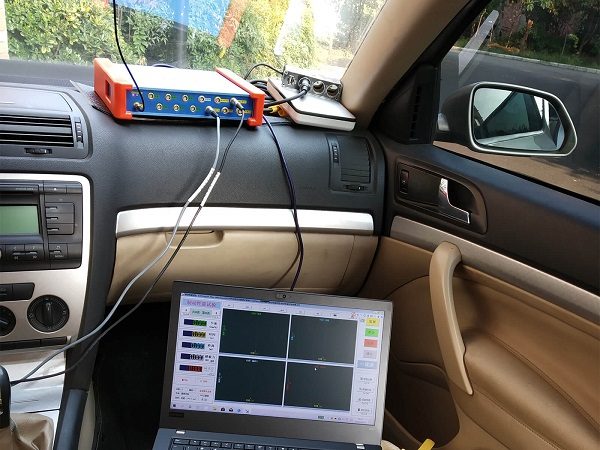
Instrument accuracy
The source gives the following accuracy requirements: control force 2%, deceleration 5%, vehicle speed 1%, braking distance 1%, time 1 s, temperature 5% and line pressure 2%.
General procedure
- Start or reset the braking test system.
- Enter vehicle parameters and select the required test items.
- Check the road, equipment and vehicle before beginning.
- The driver follows the procedure for the selected test while the system acquires, stores and displays data automatically.
- Print the results and evaluation after the test.
Different braking tests apply to different vehicle conditions. Braking performance combines response time, stopping distance and other parameters, so the measuring system must satisfy the relevant requirements. Luoyang Naiou Electric supplies braking test systems and peripheral sensors. Please leave an enquiry or contact customer service for details.