
Modern vehicles include several safety systems, including ABS. This article explains its purpose and the equipment and requirements used to evaluate its performance.
1. ABS overview
ABS means anti-lock braking system. It prevents wheel lock during braking. It normally does not intervene unless braking reaches the system's intervention threshold, at which point the driver may feel strong pedal pulsations.
Locked front wheels remove steering ability and make obstacle avoidance difficult. Locked rear wheels can cause lateral skidding. ABS automatically regulates wheel braking force, allowing the wheels to continue rolling with controlled slip, limiting severe tyre-road friction and wear and helping the driver retain control.
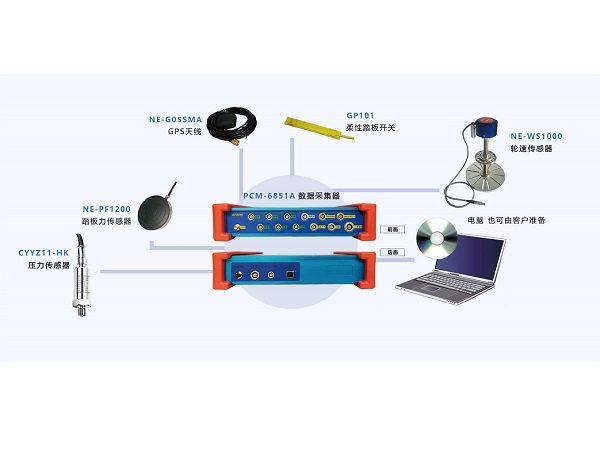
2. Performance testing
ABS test equipment
A typical test system includes a data acquisition unit, wheel-speed sensors, pedal-force sensor, brake-pressure sensor, flexible pedal switch and a laptop running test software. Install each sensor at its required location and conduct emergency braking on a dedicated test road. After ABS intervention, the system measures speed, time, braking distance, pedal force and other parameters. The software calculates the performance results.
Requirements cited in the historical source
- Electrical faults or abnormal sensors affecting function or performance—including power supply, controller external circuitry, controller or modulator failures—must trigger a dedicated visual warning to the driver.
- Except for the M and N1 categories as written in the source, a motor vehicle fitted with ABS and permitted to tow an ABS-equipped trailer requires a separate compliant trailer-ABS visual warning. It must operate automatically and remain off when no trailer, or a trailer without ABS, is connected.
- On ABS failure, remaining braking performance must meet the corresponding vehicle provisions in section 4.2.4 of GB 12676-1999 for failure of service-brake transmission components. This does not justify departing from emergency-braking requirements. For a trailer with the fault described in item 1, remaining braking performance must be at least 80% of the specified laden service-brake performance.
- ABS must continue operating despite adverse magnetic or electric fields, with verification under GB/T 17619. Disturbance testing on an ABS-equipped vehicle must comply with GB 18655.
- Manual devices must not disconnect ABS or change its control mode, except for N2 and N3 off-road vehicles defined in GB/T 15089.
Luoyang Naiou Electric researches, designs and manufactures automotive road-test instruments. Its ABS system supports the relevant performance tests and multiple output formats for rapid report preparation. Please leave an enquiry or contact customer service.