
Handling stability affects driving experience and safety. Before mass production, chassis tuning is normally verified through road tests using a handling-stability measurement system. The following procedures describe the historical article's test methods.
1. Steady-state cornering
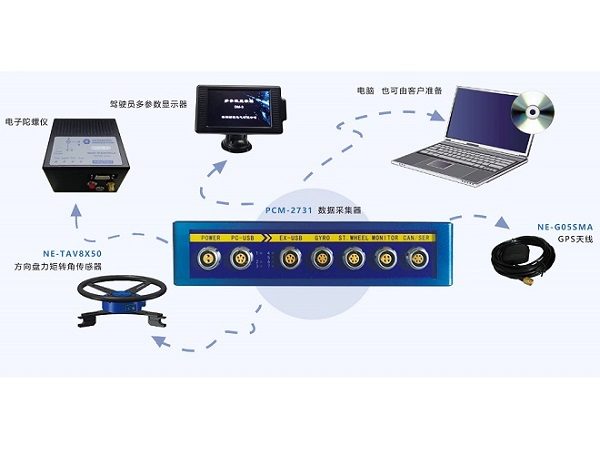
Connect the system components at the required vehicle locations, power the system and warm up the equipment and vehicle. Before testing, drive 500 m around the marked circle at the speed corresponding to lateral acceleration of 3 m/s² to warm the tyres.
Drive at a stable minimum speed on the circle. Once the speed sensor in the vehicle's longitudinal symmetry plane remains aligned with the opposite marked circle over half a lap, hold the steering wheel fixed, stop and start recording the zero lines. Move off and increase speed slowly, continuously and uniformly until lateral acceleration reaches 6.5 m/s², recording the whole process. Perform three runs in each turning direction, starting each run with the body centred.
2. Steering returnability
Low-speed test
Power the system and warm the tyres by driving 500 m on a 15 m radius circle at a speed giving 3 m/s² lateral acceleration. Begin in a straight line and record zero lines. Set steering to follow a 15 ±1 m radius circle and adjust speed to produce lateral acceleration of 4 ±0.2 m/s². Hold the steering angle and speed constant and start recording. After 3 s, release the steering wheel abruptly and mark the event. Record vehicle movement for at least 4 s after release, keeping throttle opening unchanged.
High-speed test
For vehicles with maximum speed above 100 km/h, perform a high-speed returnability test. The source specifies 70% of maximum speed, rounded to the nearest multiple of 10, for the speed basis. Drive straight at test speed and record zero lines. Apply steering until lateral acceleration reaches 2 ±0.2 m/s². Once stable, start recording, release the steering wheel and mark the event. Record at least 4 s after release without changing throttle opening.
3. Steering effort
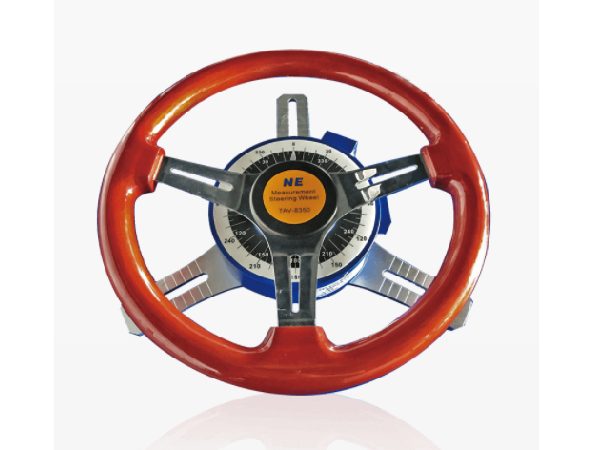
Use a marked figure-of-eight course with cones. Power the system and drive several laps to warm up and become familiar with the vehicle and course. Coast straight along the tangent at the course centre and stop there. Check that the wheels point straight ahead, correct if needed, release the steering wheel and record the centre-position and torque zero lines.
Drive the figure of eight at 10 ±2 km/h. Once speed is stable, record steering angle and torque, using vehicle speed as a monitoring parameter. One lap back to the recording start completes a test. Perform three tests, keeping speed steady and steering smoothly; do not knock over cones.
4. Steering transient response
Step input
Power the system and warm the vehicle with a 10 km drive. Determine input angle from steady-state lateral accelerations of 1–3 m/s², testing in 0.5 m/s² steps from 1 m/s². Drive straight at 70% of maximum speed, rounded to a multiple of 10. Gently take up steering free play in the input direction and record zero lines. After 0.2–0.5 s, turn as quickly as possible to the selected position, hold for several seconds and stop recording. Maintain speed throughout. Test both left and right, alternating or consecutively.
Pulse input
Power and warm the system and vehicle. Drive straight at test speed with yaw rate 0 ±0.5°/s and mark steering centre. Apply a triangular steering-angle pulse by turning left or right and quickly returning to the original position, then hold. Record until straight-line travel is restored. Input pulse width is 0.3–0.5 s, with maximum angle chosen to produce peak lateral acceleration of 4 m/s² during the transient. Minimise steering-angle overshoot and keep throttle opening unchanged.
5. Slalom
Power the system and allow the driver to become familiar with the vehicle and course. Approach at a steady speed approximately half the reference speed. Record zero lines before entering, then drive the slalom while recording time histories and the time through the valid cone section. Increase speed, without exceeding 80 km/h, and repeat for ten valid tests. Runs that knock over cones do not count.
6. On-centre steering
This is an open-loop test on a straight, level road, starting from constant-speed straight travel. The standard speed is 100 km/h; higher or lower speeds may be used in 20 km/h steps. Apply an oscillating steering-angle input, preferably sinusoidal, though triangular input is also permitted.
The reference input frequency is 0.2 Hz, with deviation no greater than ±10%. Set angle amplitude to achieve the reference lateral-acceleration peak, also within ±10%. To obtain data at 1 m/s² while operating the vehicle and subsystems beyond the hysteresis region, the reference peak is 2 m/s². Smaller values or other values not exceeding 4 m/s² may also be used.
Luoyang Naiou Electric combines research, manufacturing, sales and service, and works with automotive testing centres and research institutes. It supplies handling-stability systems and matching equipment and sensors. For details, leave an enquiry or contact customer service.