
Pass-by noise is a necessary vehicle test. It assesses the noise experienced by residents and pedestrians as a vehicle passes streets or residential areas. The test recreates that environment and uses instruments whose response represents human hearing.
Operating principle
System components
The system comprises a data acquisition unit connected to a sound level meter, driver multi-parameter display, wireless data transmission module and computer software. A dedicated microphone captures pass-by noise. The sound level meter acquires and weights the signal and sends the data to the acquisition unit. The driver display also supplies operating data. The acquisition unit organises and calculates the measurements, then sends the results to the computer software.
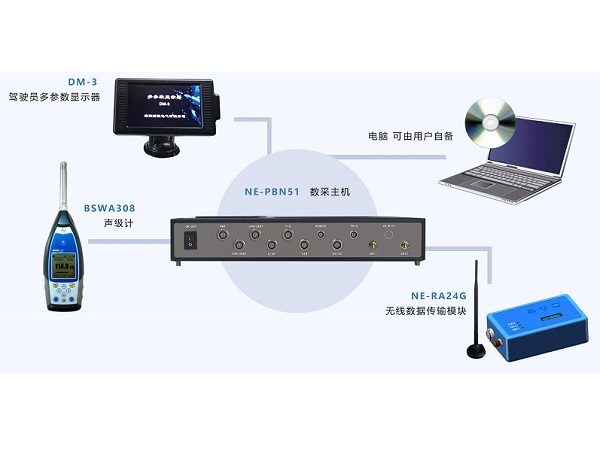
Sound level meter
The sound level meter is a core component, comprising a microphone, preamplifier, signal processor and display. Unlike a simple voltage meter, it can represent the time response of hearing, its different sensitivities to low and high frequencies, and frequency-response changes associated with loudness. A condenser microphone provides accurate, stable and reliable conversion from sound to an electrical signal. Its weak output is first amplified and then processed.
Pass-by noise sources
At high speed, noise comes both from the vehicle itself and from interaction with objects it contacts. Pass-by testing measures their combined effect.
- Intake noise: increases with engine speed; the air filter also radiates noise.
- Exhaust noise: includes the tailpipe outlet, exhaust pipes and components, and exhaust pulses. The source describes combustion noise as dominant at low speed, tailpipe noise as related to engine speed, and friction noise as more prominent at high engine speed.
- Engine-radiated noise: passes through the engine casing into the air and is directly related to speed, generally at comparatively low frequencies. Fans, starters and other auxiliaries also radiate noise.
- Tyre-road noise: tread contact creates cavities in which air resonates. Frequency and level depend on tread width, depth, shape and spacing, road condition and vehicle speed.
- Aerodynamic noise: the source regards this as comparatively negligible below 60 km/h. At higher speeds, airflow around the body and items such as mirrors and aerials generates noise.
Pass-by noise testing assesses the complete noise produced during travel. A comprehensive, accurate system is therefore essential. Luoyang Naiou Electric develops and manufactures pass-by noise systems and matching peripheral sensors to provide complete testing solutions. Please leave an enquiry or contact customer service.