
Fuel economy is an important consideration when purchasing a vehicle. With the required power performance maintained, lower fuel consumption means better operating economy. Vehicles are normally tested against the relevant requirements before leaving the factory.
1. Fuel-economy testing methods
Depending on how operating factors are controlled, methods include uncontrolled road tests, controlled road tests, road driving cycles covering constant-speed, acceleration, braking and idling consumption, and indoor cycles on a chassis dynamometer. Fuel consumption is measured mainly by road or bench testing.
Constant-speed road testing
The vehicle must be fully warmed up and in normal operating condition. Before each measurement, drive at a speed as close as possible to the test speed for at least 5 km to stabilise temperature. The test mass described here is kerb mass plus 180 kg. To establish consumption at a specified speed, perform at least two runs at or below that speed and two at or above it.
Fuel-consumption tests for commercial buses and trucks
Use a straight, level, clean, dry and flat asphalt or concrete road of sufficient length, with longitudinal gradient ≤0.1%. Measure unladen constant-speed consumption at 60 km/h as the reference. At each test speed, make two runs in each direction, check repeatability and calculate the arithmetic mean of consumption results.
For the laden test, use top or next-to-top gear for a manual transmission and the forward position for an automatic transmission. After travelling steadily for at least 100 m at the selected speed, pass through a 500 m test section at constant speed and measure the time and fuel consumption.
Chassis-dynamometer testing
- Set the test speed: 60 km/h for passenger cars and 50 km/h for other vehicles in the procedure described.
- Drive onto the rollers, start, accelerate and select direct gear to reach the specified speed.
- Apply the dynamometer load PPAU to simulate the road-resistance power of a fully laden vehicle travelling at constant speed on a good, level road.
- Once speed is stable, measure consumption over at least 500 m, twice consecutively, and record the results.
- Calculate constant-speed consumption per 100 km.
2. Fuel-economy measuring equipment
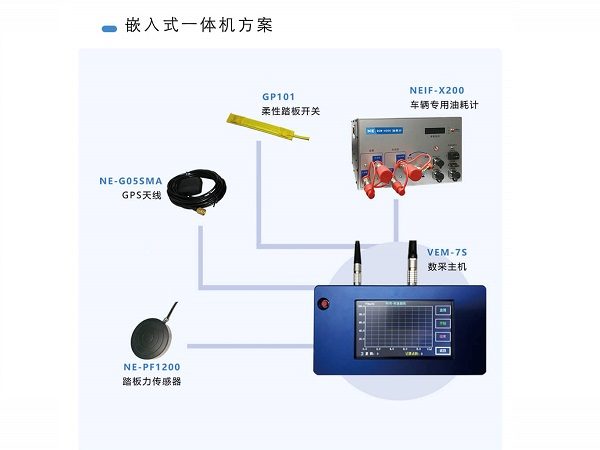
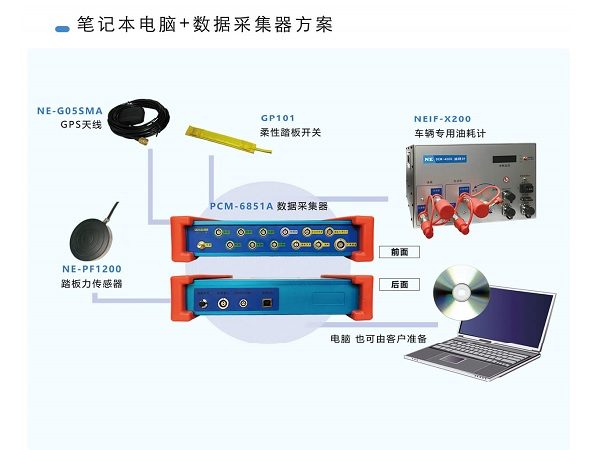
A vehicle economy testing system is the main road-test equipment. Bench tests may use a driving-cycle fuel-consumption system. A fuel meter and recorder measure consumption. Most meters support continuous cumulative measurements, but their flow ranges and measurement errors differ.
A meter comprises a fuel-consumption sensor and a display or secondary instrument. Methods include volumetric measurement, gravimetric measurement including differential-pressure weighing, and carbon-balance calculation using exhaust analysis. Volumetric instruments include fixed-volume measuring tubes and displacement meters using diaphragms, reciprocating pistons or linked four-piston mechanisms.
Connecting a driving-cycle fuel-consumption system
Fuel entering the sensor must contain no gas. All fuel counted by the sensor must reach the combustion chamber without being counted again. In the petrol system described, connect the sensor in series between the fuel pump and carburettor: pump outlet to sensor inlet, sensor outlet to carburettor inlet. In a diesel system, connect it between the tank and high-pressure pump and return fuel to the sensor outlet line. Large-flow engines may generate bubbles through cavitation; an auxiliary pump between the tank and sensor can prevent resulting errors.
3. Operating precautions
- When using only a sensor on a petrol vehicle, return excess fuel to the sensor outlet.
- If negative pressure between the diesel sensor and injection pump causes cavitation, an auxiliary pump may be needed. The source gives approximately 20 kPa for fuel pressure from the tank. Keeping the pump inlet line at positive pressure supports stable measurement.
- If resistance in the return line raises regulator operating pressure above the specified value, a return-treatment tank vented to atmosphere can address the problem.
Luoyang Naiou Electric develops, manufactures, sells and supports vehicle economy testing systems and complete sets of peripheral sensors. For further information, please leave an enquiry or contact customer service.