
Vehicle performance tests often use an additional wheel connected to measuring equipment. This assembly is called a fifth-wheel instrument. It provides a convenient way to measure vehicle performance during road testing.
1. Measurement applications
- Acceleration: records initial speed and the full acceleration process. It can also measure acceleration from a standing start through successive gear changes.
- Coastdown distance: records speed against time after the transmission is disengaged until the vehicle stops, together with distance travelled. The speed-time curve can also be used to calculate rolling and aerodynamic resistance.
- Maximum speed: measures the stable maximum road speed, rather than a momentary peak, while recording real-time speed throughout the run.
- Gradeability: helps measure constant-speed travel when a fully laden vehicle climbs a gradient on a good road surface.
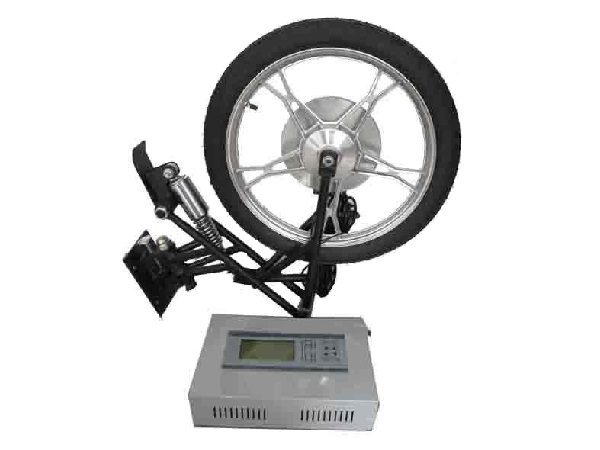
2. Components and operating principle
A conventional contact fifth-wheel assembly includes the wheel, sensor, secondary instrument and mounting frame. The sensing assembly consists principally of the fifth wheel, a magnetoelectric sensor mounted on its frame and a toothed disc.
Rotation changes the magnetic field at the sensor, producing an alternating signal in its coil. A conditioning circuit converts it into pulses supplied to the secondary instrument. Counting pulses provides the distance travelled. In the contact system described in the source, an inductive travel sensor typically produces one signal per centimetre of travel.
A quartz crystal oscillator provides the time reference and controls the sampling gate. A counter-decoder counts travel pulses and a digital display shows distance over a specified time interval, and thus average speed. The typical interval stated is 36 ms. A digital-to-analogue converter can also supply a voltage to a tape recorder. During acceleration tests, the display gives acceleration time and the recorder captures the entire process, from which an acceleration-distance curve can be obtained.
In addition to fifth-wheel equipment, Luoyang Naiou Electric develops and manufactures systems for acceleration, fuel economy, braking and other vehicle tests to meet the associated automotive test requirements. Please leave an enquiry or contact customer service for details.