
Ride comfort is often evaluated subjectively during vehicle development. Objective vibration measurements provide a repeatable basis for assessment. The historical article describes acquisition requirements with reference to GB/T 4970-2009.
Data acquisition requirements
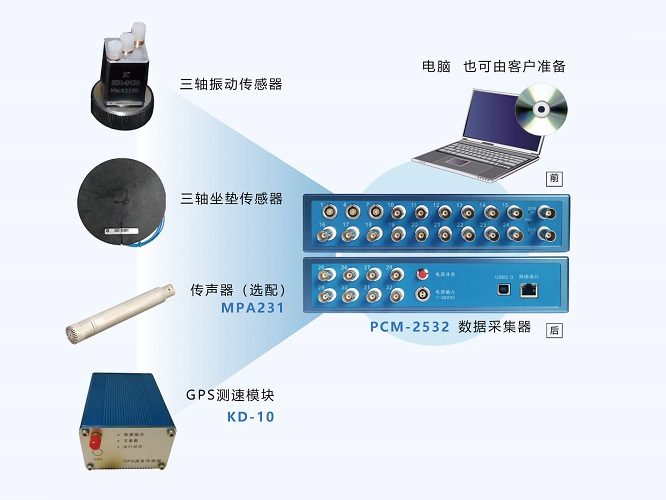
- Sensor positions: for category M vehicles, measure vibration in three directions at the driver's and same-side rear passenger's seat cushion, seat back and footwell floor. For category N vehicles, also measure vertical vibration at the load-platform centre and at a floor point 300 mm from both the side and rear boards on the driver's side.
- Signal bandwidth: one-third-octave centre frequencies cover 0.5–80 Hz. The upper frequency of the 80 Hz band is 90 Hz, so acquired time-domain bandwidth must be at least 90 Hz.
- Frequency resolution: the source gives no greater than 0.2 Hz for power spectral density evaluation. It further states no greater than 0.19 Hz to ensure a spectral line in the lowest one-third-octave band, whose boundaries are 0.45 and 0.57 Hz.
- Signal duration: random-input tests require at least 25 independent samples. The source specifies acquisition longer than 25 frames, with each frame duration equal to the reciprocal of frequency resolution.
- Repeat runs: at least five valid tests at each speed.
Uses of measured data
As acquisition equipment and post-processing improve, objective measurements are increasingly used in chassis development. They support detailed simulation models, allow performance and cost trade-offs to be explored, and provide intuitive, repeatable methods for evaluating whole-vehicle performance.
Luoyang Naiou Electric's ride comfort test and analysis system supports the applicable test and processing procedures, suspension natural-frequency and damping-ratio measurements, and general vibration analysis. Please leave an enquiry or contact customer service for details.