
Power performance supports basic vehicle operation. Better performance generally permits higher average speeds and improves the productivity of transport vehicles.
1. Evaluation criteria
Maximum speed
This is the maximum stable speed achieved at the manufacturer's maximum gross mass on a dry, clean, level concrete or asphalt road, with wind speed ≤3 m/s. A chassis-dynamometer test has different conditions and is useful for comparison, but cannot fully replace a road test.
Acceleration
Acceleration is measured by the shortest time required to reach a higher speed from a lower one. Standing-start time is the time from starting in first or second gear and shifting progressively at maximum acceleration to a target such as 80 km/h. Overtaking acceleration is measured in top or next-to-top gear from an intermediate to a higher speed, commonly 40–50, 40–80 or 40–100 km/h.
Gradeability
This is the steepest gradient that a vehicle at rated load can climb at constant speed in first gear on a good road. A maximum-gradient test is normally part of vehicle approval or finalisation.
2. Road-test equipment
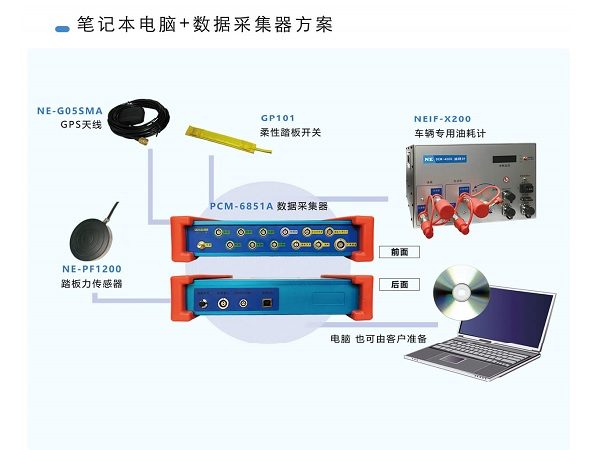
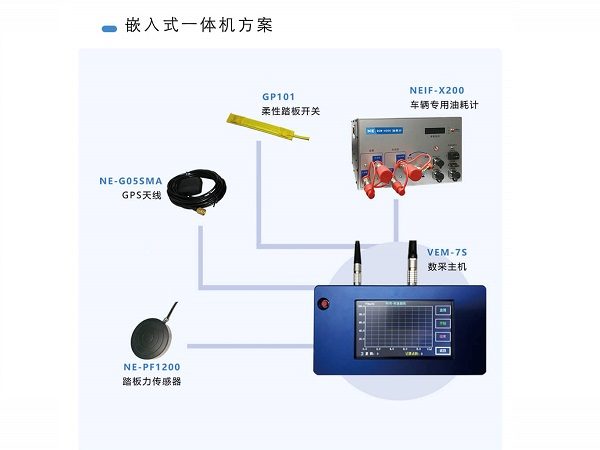
A fifth-wheel instrument is commonly used, with accuracy at least 0.5% and timer resolution of 0.1 s. Naiou offers two power-performance system arrangements:
- Computer plus acquisition unit: acquisition unit, flexible pedal switch, GPS antenna, pedal-force sensor, driver multi-parameter display and laptop with test software.
- Embedded integrated system: acquisition host, driver multi-parameter display, pedal-force sensor, flexible pedal switch and GPS antenna.
The system supports both conventional and new-energy vehicles, with accurate speed measurement, efficient data management and convenient operation.
3. Road tests
Maximum speed
Close the windows and switch off auxiliary equipment. Select the gear appropriate to the designed maximum speed. Once the maximum speed is stable, measure the time over 1 km.
Acceleration
For a standing start, select the starting gear, move off quickly and apply full throttle. At the engine speed for maximum power, shift quickly and smoothly, immediately applying full throttle again. Continue through successive gears until the preset speed or distance, recording speed, time and distance. Automatic-transmission vehicles use D.
For overtaking acceleration, select the preset gear and do not shift during the run. Begin at the specified constant speed. On entering the test section, apply full throttle and accelerate as rapidly as possible to the specified speed or distance while recording speed, time and distance. Automatic vehicles again use D.
Gradeability
Test on slopes of different gradients whose lengths exceed two to three vehicle lengths. In the lowest gear at full throttle, the steepest slope successfully climbed establishes the maximum gradient. If the available gradient does not match the vehicle's limit, adjust load or gear and calculate the equivalent maximum gradeability.
Luoyang Naiou Electric combines research, production, sales and service. Its systems support conventional and new-energy vehicles and, with selected equipment, also measure braking and fuel consumption. Please leave an enquiry or contact customer service.