
Vehicles are widely used for transport. As their numbers grow, accidents, air and noise pollution, and passenger and pedestrian safety require attention. Complete-vehicle performance inspections are needed before factory release and after periods of operation.
1. Inspection areas
Power performance
Bench and road tests measure driven-wheel power and tractive force, coastdown distance, maximum speed, acceleration, gradeability and drivetrain efficiency.
Fuel economy
Fuel economy is the ability to travel with minimum fuel while maintaining required power performance. It depends on the engine, transmission and running gear. Results are commonly expressed as consumption per 100 km under specified conditions, or distance travelled on a given quantity of fuel. Methods include uncontrolled, controlled and cycle road tests, plus bench tests.

Braking
Inspection covers effectiveness, resistance to thermal fade and directional stability. Effectiveness is assessed by stopping distance, deceleration or force on a good road from a specified initial speed and pedal force. Fade resistance is the thermal stability during high-speed, repeated or continuous downhill braking. Directional stability is the ability to maintain a straight path or intended curve while braking.
Speedometer
A large indication error prevents accurate speed judgement and can contribute to accidents. Speedometer error is therefore among the required safety inspection items described in the source.
Headlamps
Vibration can shift mounting positions and beam direction. Ageing bulbs and contaminated reflectors reduce brightness. These changes impair visibility or dazzle oncoming drivers, so luminous intensity and beam direction require inspection.
Exhaust emissions
Exhaust analysis controls harmful emissions and evaluates engine condition, particularly fuel supply and ignition. Emissions are included in the safety inspections described.
Noise
Moving vehicle noise affects many people over large areas and long periods. Noise testing and control help protect health and provide better living, working and learning environments.
2. Instruments and equipment
Chassis dynamometer
Indoor power-performance inspection uses driven-wheel output power or tractive force as diagnostic parameters. A chassis dynamometer measures these values. Comparing wheel power with engine flywheel power gives drivetrain efficiency and helps diagnose transmission condition.
Fifth-wheel instrument or complete-vehicle test system
A fifth wheel fitted beside or behind the vehicle is a free-running measuring wheel. Without driven-wheel slip, it can measure distance accurately on flat roads and provides distance, time and speed in acceleration, coastdown and braking tests.
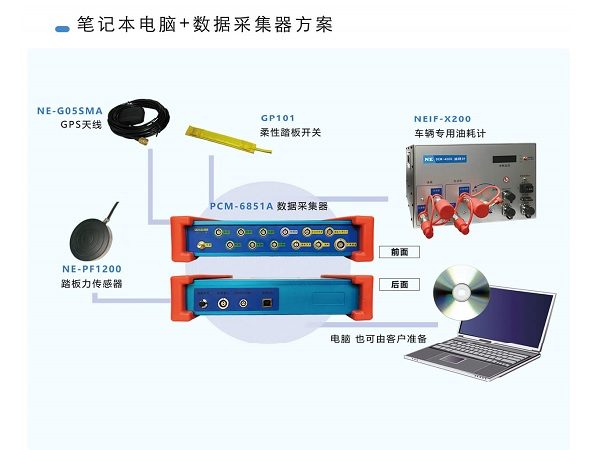
A complete-vehicle system combines an acquisition unit with devices such as a fifth wheel, speed/distance recorder, dedicated fuel meter, pedal-force sensor and flexible pedal switch. It supports coastdown distance, minimum stable speed, maximum speed, acceleration, gradeability, economy and braking tests.
Speedometer test bench
This comprises speed measurement, indication, warning and lifting equipment. The vehicle wheels rotate two pairs of rollers, which represent a moving road. With pure rolling and no slip, roller and wheel circumferential speeds are equal. Roller diameter and measured rotational speed provide actual vehicle speed.
Headlamp inspection calibrator
A standard light source with a rotatable optical axis includes a lamp, stabilised DC supply, voltmeter, angle rotation/readout, levelling and alignment mechanisms. It calibrates high-beam inspection instruments for intensity and beam direction by comparison.
Exhaust analysers
- Non-dispersive infrared (NDIR) analyser: determines petrol-engine exhaust pollutant concentrations from changes in infrared energy absorbed at selected wavelengths.
- Filter-paper smoke meter: collects diesel smoke on paper and determines smoke level from the change in optical reflectance as the paper darkens.
- Opacity meter: determines diesel smoke from attenuation of light passing through the exhaust.
Sound level meter and noise test system
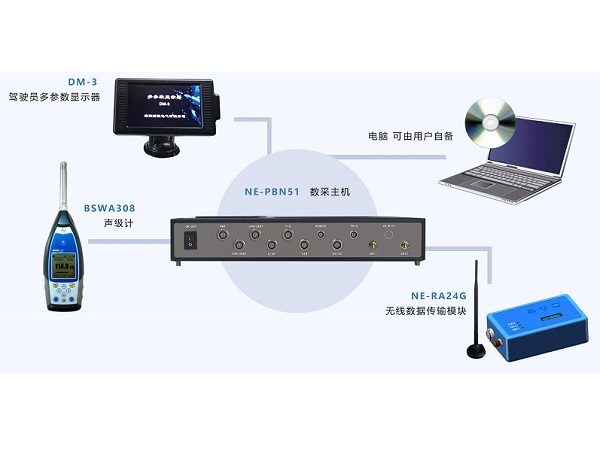
A sound level meter approximates human auditory response when measuring industrial or vehicle noise. A portable precision instrument is compact and light for on-site use. Typical components are the microphone, preamplifier, attenuator, amplifier, A-weighting network, detector, indicating instrument and power supply. Together with an acquisition unit and driver multi-parameter display, it forms a vehicle noise system for road tests on dedicated sites.
Luoyang Naiou Electric researches, manufactures and sells vehicle performance testing equipment, drawing on years of road-test instrument design experience. Please leave an enquiry or contact customer service for details.