
As new-energy vehicles and intelligent driving develop, passenger-car braking is increasingly electronically controlled. The historical article describes GB 21670-2025, Technical Requirements and Test Methods for Passenger Car Braking Systems, as replacing the 2008 edition and introducing requirements for electronically transmitted braking and functional safety.

1. Changes described in the source
Broader coverage of braking technologies
The source describes requirements for regenerative braking systems and electronically transmitted braking systems, distinguishing category A and B regenerative braking. It states that category A regeneration must not stop the vehicle solely on accelerator release in the default setting, that M1 passenger cars with up to nine seats require category 1 ABS, and that category 2 and 3 ABS provisions are removed. It also specifies brake-lamp activation when regenerative deceleration exceeds 1.3 m/s².
More demanding test measurements
The article describes a test-speed tolerance change from not below 98% to ±2%, and response-time test speed increasing from 20 to 100 km/h. It reports new energy-storage tests for electronically transmitted braking, requiring nine effective braking applications after a single failure.
Functional safety and fault testing
The source describes new Appendices B–F with functional safety requirements for electronic braking control, including safety goals for four hazards such as unintended deceleration and lateral motion. Fault injection, including wheel speed sensor failure and ECU electrical faults, is used to verify protective measures.
2. Test equipment capabilities
Compatibility across systems
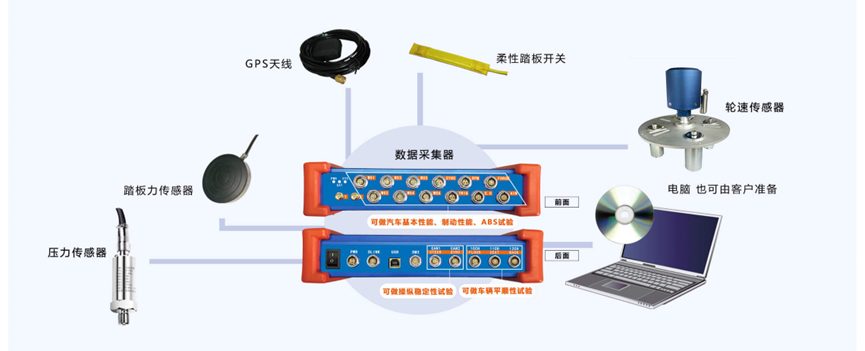
The article presents Naiou's equipment as supporting ABS, regenerative and electronically transmitted braking, including type 0 cold-brake tests and type I fade and recovery tests. It describes simultaneous capture of braking signals and deceleration curves, including the 1.3 m/s² brake-lamp threshold.
Traceable data and reports
The source describes recording braking force, deceleration and response time, with measurement error no greater than 1%, and reports intended to support regulatory approval review without repeated data processing.
3. Preparing during the transition
The article gives a transition of 13 months after implementation for already type-approved models, while newly submitted models must comply immediately. It recommends assessing existing equipment's compatibility with regenerative and electronically transmitted braking, building fault simulation environments, validating key models early and preparing report templates for Appendices C and D.
Naiou provides equipment, test solutions and support for braking performance evaluation. Contact us to discuss a solution for your requirements.