
Braking performance is critical to vehicle safety, but braking force alone is insufficient. ABS prevents wheel lock during emergency braking, helping avoid unstable sliding and loss of control. The source refers to GB 21670-2008 for passenger cars and GB 12676-2014 for commercial vehicles and trailers as prescribing ABS test requirements.
Accurate evaluation of braking and traction control requires wheel speed information. Conventional sensors use encoder pulse outputs. A mounting fixture and stator restraint connect the encoder to the wheel so they rotate together. Pulse frequency provides wheel rotational speed.
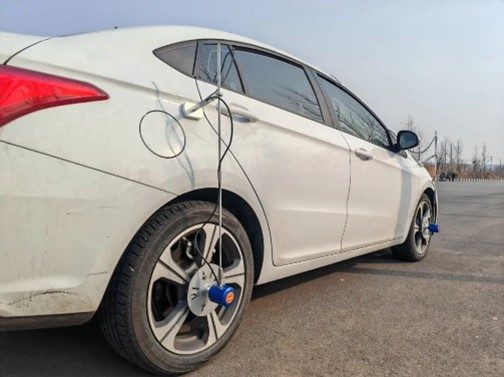
Installation of a wired wheel speed sensor.
Conventional wired sensors require complex cable routing, lengthy installation and additional reference mounting equipment for each wheel. The acquisition unit must connect to every wheel. On commercial vehicles and machinery with six, eight or more wheels, cable quantity and length increase substantially, complicating field testing.
Naiou's wireless wheel speed sensor transmits measurements to a receiving unit without these signal cables, simplifying installation.
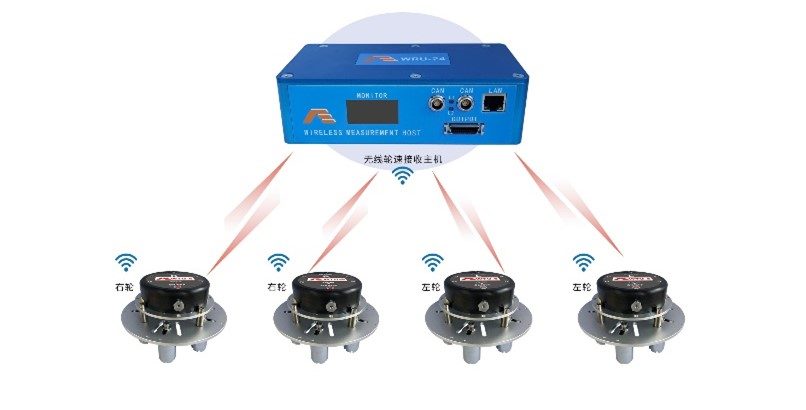
Wireless wheel speed sensor test system.
The system includes four measurement modules and one receiving module. Each measurement module combines one rotational-speed channel, four temperature channels, one pressure channel, a rechargeable battery and a wireless transmitter. Speed, temperature and pressure are measured synchronously and sent to the main receiver.
Advantages
1. Fast, adaptable installation
No complex wiring or stator restraint is required. Fixtures or adapter nuts attach directly to the original wheel. The system suits passenger cars, commercial and special-purpose vehicles, indoor bench tests and outdoor road tests.
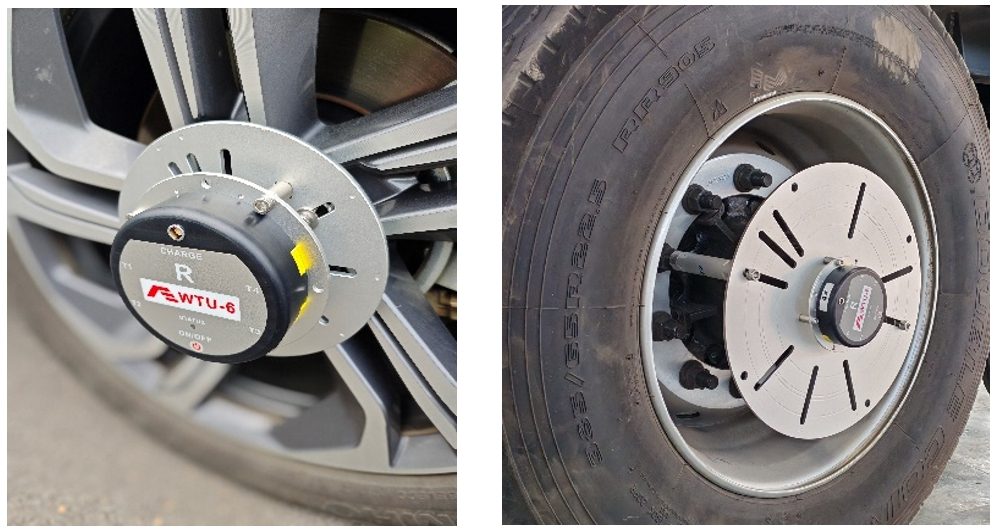
Installed wireless wheel speed sensor.
2. Efficient, stable data transmission
The source reports stable wireless transmission across test environments with resistance to electromagnetic interference, supporting real-time feedback for dynamic control evaluations.
3. Multi-wheel measurement
Receiving modules can be cascaded for six, eight or twelve wheels, measuring speed, temperature and pressure. Built-in cascade connectors join modules without external interconnection cables.
4. Multiple output formats
Measurements from all wheels can be output synchronously over CAN. Each main module also provides analogue and digital outputs for connection to different acquisition systems.
Applications include whole-vehicle testing, ABS evaluation and optimisation of vehicle dynamic control. As automated driving develops, timely and accurate wheel speed data become increasingly important. Please leave an enquiry or contact us for more information.